

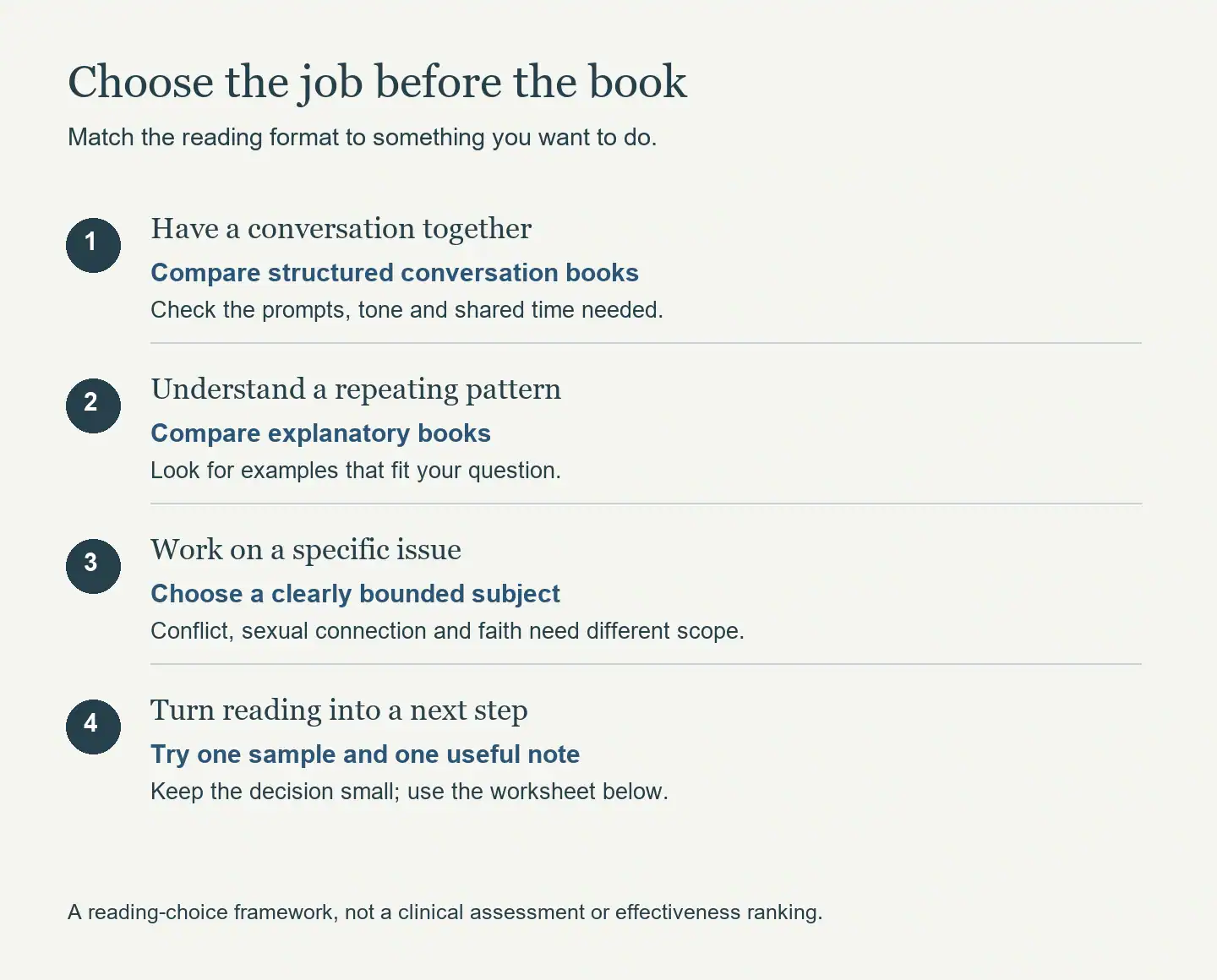
For a book you can use together, compare Hold Me Tight and Eight Dates. For a broad marriage framework, look at The Seven Principles for Making Marriage Work. For questions about closeness, distance and attachment, begin with Attached, Secure Love or Love Sense.
The useful choice depends on the job you want the book to do: explain a pattern, guide a conversation or explore a particular part of your relationship. This guide compares those jobs, the work each format asks of you and the details to check in a sample.
Choose a book for the question you have now
Write down one question before comparing titles. “How do we begin a difficult conversation?” gives you a clearer buying test than “Which book will fix our relationship?” You can then look for a chapter or exercise that actually addresses it.
| Your purpose | Titles to compare | Check before buying |
|---|---|---|
| Talk about emotional closeness | Hold Me Tight; Secure Love | Do the conversation examples feel understandable and usable to both of you? |
| Make time for guided discussions | Eight Dates | Are you both willing to set aside time for the suggested topics? |
| Explore everyday marriage habits | The Seven Principles for Making Marriage Work; Wired for Love | Would you use a broad framework or prefer a specific routine? |
| Understand attachment language | Attached; Love Sense; Secure | Do you want dating examples, romantic-bond explanations or a wider relationship scope? |
| Focus on conflict | Fight Right; Us | Does the sample address the particular interaction you want to understand? |
| Explore faith, sex or written practice | Created for Connection; Come Together; The Hold Me Tight Workbook | Choose the relevant subject and check its assumptions and format. |
Books for conversations and everyday connection
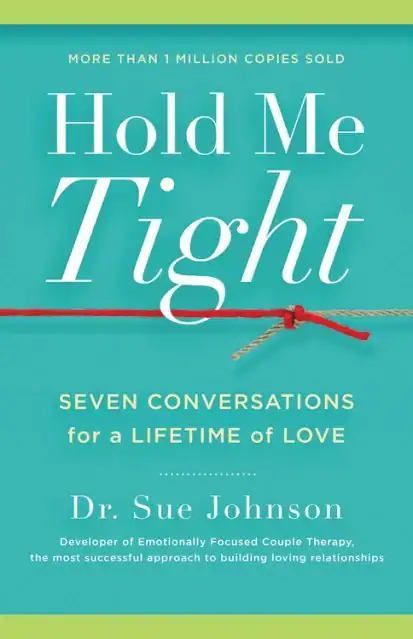
Hold Me Tight
Sue Johnson
Organized around seven conversations, this book offers a way to explore the emotional bond between partners, with examples and exercises. Compare it when your question is how to talk about disconnection and emotional needs. In a sample, check whether you want this emphasis on the bond itself. Publisher details and available formats.
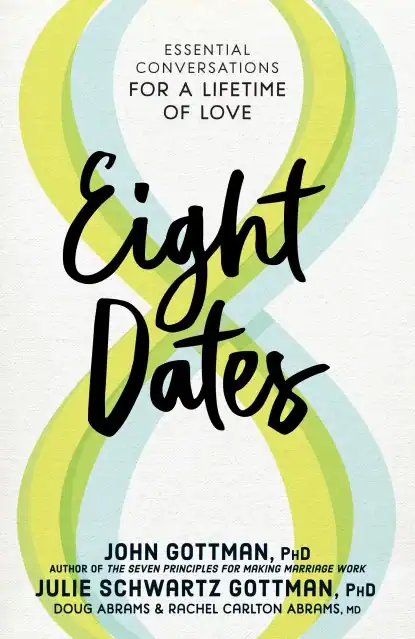
Eight Dates
John Gottman, Julie Schwartz Gottman, Doug Abrams and Rachel Carlton Abrams
This book arranges shared discussions around eight topics. It is worth comparing when you want a defined occasion for talking together. The practical buying question is whether you both want that structure and can make time for it, rather than simply adding another book to a shelf. Publisher details and available formats.
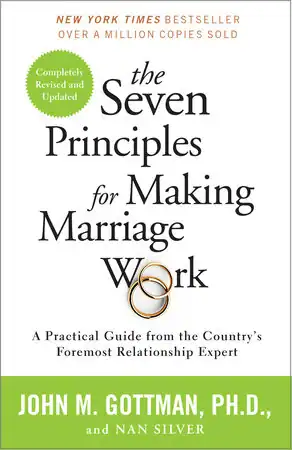
The Seven Principles for Making Marriage Work
John Gottman and Nan Silver
The revised 2015 edition offers a broad marriage framework with exercises. Consider it when you want to explore several aspects of married life in one volume. Check that the sample’s marriage framing and exercise style fit your relationship and the way you like to learn. Publisher details and available formats.
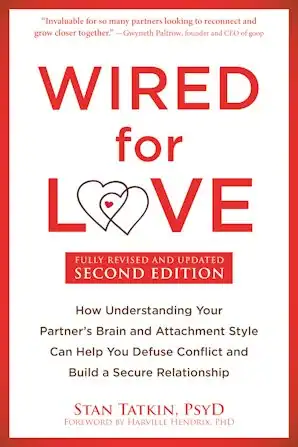
Wired for Love
Stan Tatkin
The second edition, published in 2024, presents ten principles with routines and exercises for couples. It gives another starting point for readers who want ideas connected to everyday interaction. Check the edition when comparing copies: an older listing may describe the earlier version. Publisher details and available formats.
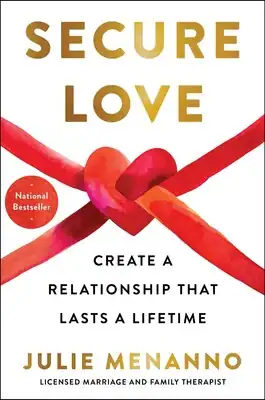
Secure Love
Julie Menanno
This couple-focused book uses attachment ideas to discuss recurring negative cycles, with communication examples and exercises. Its hardcover first appeared in 2024; a 2026 paperback listing does not make it a newly written 2026 book. Compare an excerpt if practical dialogue is your priority. Publisher details and available formats.
Books for understanding patterns
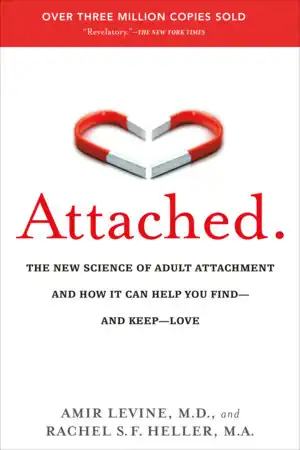
Attached
Amir Levine and Rachel S. F. Heller
This accessible introduction uses attachment categories and adult relationship examples. It may suit readers exploring dating and closeness, including those reading alone. Treat a category as a prompt for reflection. A book questionnaire cannot diagnose you, establish a partner’s motives or decide whether a relationship should continue. Publisher details and available formats.
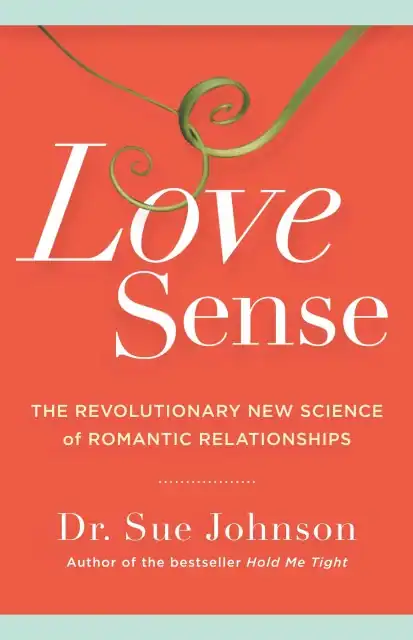
Love Sense
Sue Johnson
This book explains romantic connection through attachment and the science of bonding. Compare it when your first question is why emotional connection matters, before deciding whether you want a more structured conversation book or workbook. It has a different reading purpose from a professional therapy manual. Publisher details and available formats.
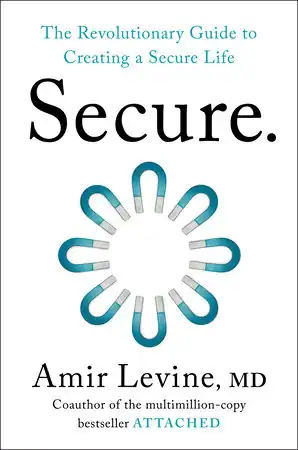
Secure
Amir Levine
Published in April 2026, this book extends its discussion of security beyond romance into relationships such as work, friendship and family. Compare it if your question reaches beyond couple life. Being newer or broader does not establish that its approach is more effective than another book’s. Publisher details and available formats.
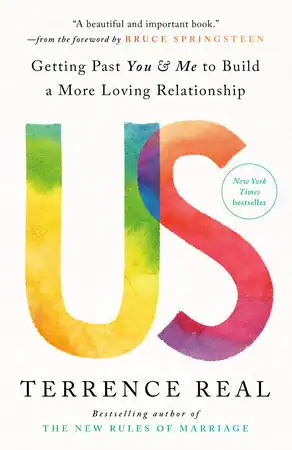
Us
Terrence Real
This book examines relationship patterns through a relational rather than solely individual perspective. Consider its examples when you want to explore what happens between two people during conflict. You can compare that emphasis with a book organized around specific conversations or daily routines. Publisher details and available formats.
Books for more specific questions
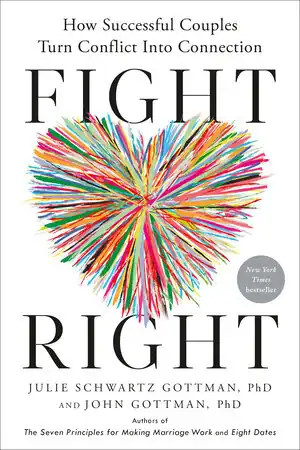
Fight Right
Julie Schwartz Gottman and John Gottman
This book focuses on how couples handle conflict. Compare its sample with a broader marriage book if arguments are the question you want to work on first. The hardcover was published in 2024; the publisher’s January 2027 paperback date is a future edition at this guide’s research cutoff. Publisher details and available formats.
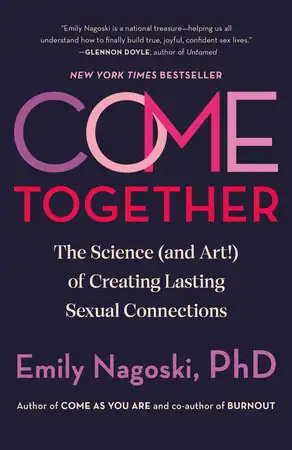
Come Together
Emily Nagoski
This book focuses on sexual connection in long-term relationships, including context and pleasure. Its subject is more specific than general communication. Preview the language and topics together if you plan to share it, and choose a pace and degree of discussion that each person freely agrees to. Publisher details and available formats.
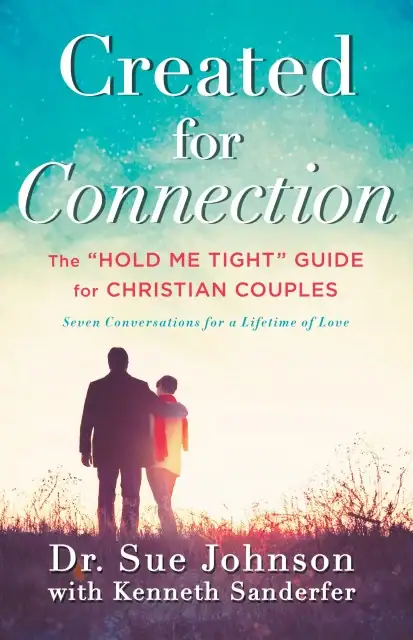
Created for Connection
Sue Johnson and Kenneth Sanderfer
This adaptation explicitly connects couple bonding with Christian faith and marriage. Choose it for that context when it reflects your beliefs and reading goals. If you want a general-audience account without that faith framework, compare the original conversation book instead. Publisher details and available formats.
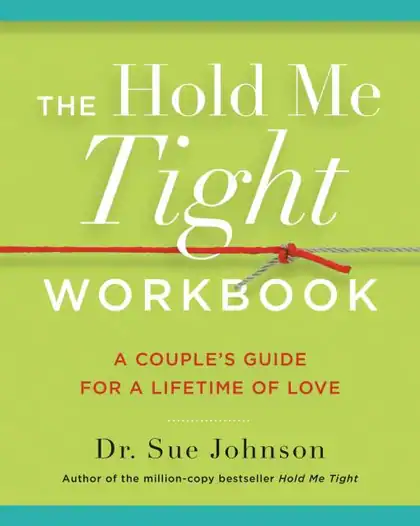
The Hold Me Tight Workbook
Sue Johnson
Published in 2022, this companion emphasizes written prompts and activities. Compare it when you prefer making notes and working through exercises. Check its relationship to the original book and the space or format provided for responses before choosing a print or digital copy. Publisher details and available formats.
What research can tell you about reading for a relationship
A book’s subject, author credentials and sales do not by themselves demonstrate what will happen for a particular reader. Evidence about a therapy also cannot automatically be transferred to a self-help book based on that therapy.
A randomized pilot involving 39 Danish parenting couples compared the OurRelationship online program with a book-based condition. The book condition included two copies of a Danish relationship book, a reading guide and four planned conversations. The condition evaluated a reading plan as well as the book. The small study had no untreated comparison group, so changes within either group do not establish how much the intervention caused. It does not rank the books in this guide or test Hold Me Tight Online.
A 2026 protocol for a larger trial describes planned methods, including a waitlist group. A protocol is not an effectiveness result. The practical lesson for a buyer is to check what support and participation a reading format asks for, while keeping claims about outcomes separate.
Attachment research also calls for care with labels. R. Chris Fraley’s research overview describes adult attachment anxiety and avoidance as dimensions. A 2025 study of 619 Spanish adults found that different measures supported different ways of describing attachment profiles. It cannot establish universal categories or population percentages.
This is an educational book-selection guide, not individualized care. Joint reading should be voluntary. If a relationship involves fear, coercion or violence, a shared exercise may be inappropriate; seek individual support from a qualified professional or local specialist service.
Use a sample before buying
Publisher links in each book entry lead to current descriptions and available formats; some include a reading sample. Try the same check on two candidates. A library copy can also help you evaluate a book without buying it first.
A sample-reading worksheet
- My question: What do I want this book to help me understand or discuss?
- The relevant passage: Which chapter, example or prompt directly addresses that question?
- The participation required: Can I use it alone, or does it depend on a willing partner? What time or materials would it need?
- My next step: Borrow, buy, try another sample or seek a different kind of support?
You can copy these prompts into a notebook. They are an editorial buying aid, not a validated assessment.
Check the format as well as the title
Print may suit marking passages and writing responses. An ebook may suit adjustable text and searching. If you prefer audio, check whether an accompanying PDF or workbook is included and usable on your device. Those features vary by edition and seller, so confirm them in the specific listing.
When only one partner wants to read, choose material you can use for your own reflection. Shared prompts depend on two willing participants. A book cannot supply another person’s consent or participation.
If attachment is your main question, use the more focused attachment theory reading guide to compare introductory, workbook and professional options.
Cover images identify the editions shown. Designs can differ by format or region; check the linked publisher listing before buying.
How this guide was assembled
Titles were selected for distinct adult reading purposes, with publisher records used to check authors, scope and editions as of 10 November 2026. Publisher descriptions and available excerpts support the comparisons; they do not establish clinical benefit. The worksheet and purpose-to-book table are editorial aids. No numerical effectiveness scores were assigned.
Further research informing the evidence boundaries: attachment and emotion-regulation flexibility (2024); a longitudinal couple communication study (2026); a self-compassion and attachment meta-analysis (2025); and attachment, stress and romantic relationships (2017). These address attachment processes and associations, not head-to-head tests of these books.